
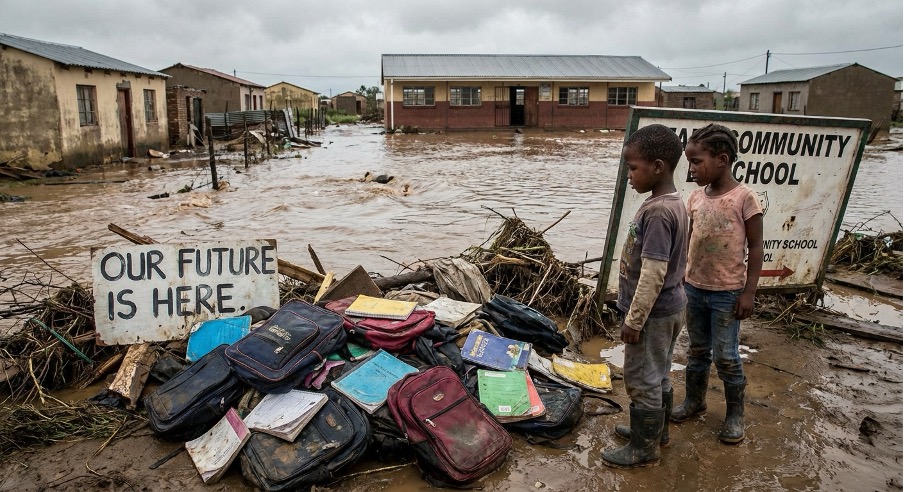
When the disaster struck, so did our resolve to protect every child’s dream.
In 2023, as the Akosombo Dam spillage sent floodwaters sweeping through communities in the Eastern, Greater Accra, and Volta Regions of Ghana, the cost of the disaster was not only in the submerged homes and displaced families, but in classrooms left silent and school bags and books washed away. Days of missed school often translate into huge learning losses that could have lifetime consequences. For many children, the devastation felt painfully familiar. Just a few years ago, COVID-19 had led to school closures that halted learning with many children unable to take advantage of the digital learning tools that were introduced. Now again, school supplies purchases with hard-earned income lay buried beneath muddy waters, casualties of forces far beyond their control.
At the same time, recurring conflict in Bawku and its surrounding areas often forces schools to shut down, sending teachers and learners fleeing for safety rather than walking into classrooms. Across these different emergencies — whether driven by climate, disease, or conflict — the cost remains the same: interrupted education and fragile dreams. Children who live in these communities have dreams of becoming doctors, engineers, teachers, entrepreneurs and leaders capable of changing their families’ stories and that of their communities. Each disruption, however, exposes a troubling truth: that the educational systems meant to protect and nurture these aspirations are fragile, often ill-prepared for shocks, and deeply unequal in their ability to respond.
These scenes are repeated across Africa where research shows that four persistent stressors repeatedly threaten the stability of education systems. Systemic weaknesses — from policy gaps to inadequate physical and digital infrastructure — leave schools exposed even in communities spared by the recurrent shocks. Climate-related events, especially floods, increasingly destroy facilities and displace communities. Conflict and disease outbreaks, from Ebola to COVID-19, fracture the continuity of schooling and deepen inequalities. Household vulnerabilities, driven by poverty and harmful gender norms, push already marginalized children further away from opportunity when disasters strike. Together, these pressures form a landscape in which resilience is not optional, but essential.
In response to these stressors, education systems have implemented several adaptive practices, including:
Double-shift and multi-track school systems to stretch limited infrastructure to accommodate displaced or growing populations;
Digital learning through radio, television, and computer-based platforms to extend classrooms beyond physical walls;
Incentives and continuing education programs that support teachers through uncertainty, ensuring that the heart of the system remains strong; and
Curriculum and pedagogical changes to improve suitability and system efficiency.
Still, the journey toward resilient education systems is far from complete. It is against this backdrop that the Africa Regional Education Systems Resilience Observatory (ARESRO) was born - an observatory to generate evidence to address the crisis of continuity in education across the African continent. ARESRO exists to change the narrative from one of repeated disruption to one of preparedness, recovery, and renewal. By engaging policymakers, educators, communities, and development partners across Africa, the observatory seeks to understand how education systems can withstand, adapt to, and recover from disasters, shocks, and long-term stressors. Its purpose is simple but profound: when the next alarm sounds, we should not be reacting blindly, but responding with foresight, guided by evidence and shared understanding. Through its work, ARESRO explores how Education Systems Resilience (ESR) is understood and practiced across Global Partnership for Education (GPE) countries in Africa.
In doing so, it will foster a common language and collective vision for strengthening systems that do not merely survive crises, but continue to serve learners meaningfully through them. What will emerge is a complex ecosystem of actors, each playing a vital role in sustaining education under pressure. Governments will formulate and implement policies that shape system-wide responses. Civil society organizations will continue to advocate for the most vulnerable and hold institutions accountable. These actors will work with communities and parents who form the first line of protection for learners. Teacher unions will defend the welfare and professional dignity of educators who carry the system on their shoulders during crises. Student unions will amplify the voices of the young, ensuring that reforms do not lose sight of those they are meant to serve.
Countries must prepare for the megatrends reshaping education today. Climate change and digital trends, including artificial intelligence, are no longer future expectations; they are present realities. Yet current education structures across many African countries remain inadequately prepared for their disruptive power or potential silver linings. If education is to remain relevant and accessible in the decades ahead, these forces must be urgently integrated into policy design, curriculum development, pedagogical approaches, teacher training, infrastructure planning, and monitoring systems. Horizon scanning and foresight analysis are also needed to anticipate what stressors might emerge so that systems can prepare for them.
ARESRO stands as a long-term commitment to safeguarding the dreams of young people across Africa. When floods come, when diseases spread, when conflicts arise, the goal is that education will not collapse, but endure — supported by knowledge, guided by evidence, and driven by a shared resolve to protect the future.
Because every child, regardless of the storms they face, deserves the chance to dream — and the systems that make those dreams possible should be protected and foolproof against known and theoretically feasible disruptors.