
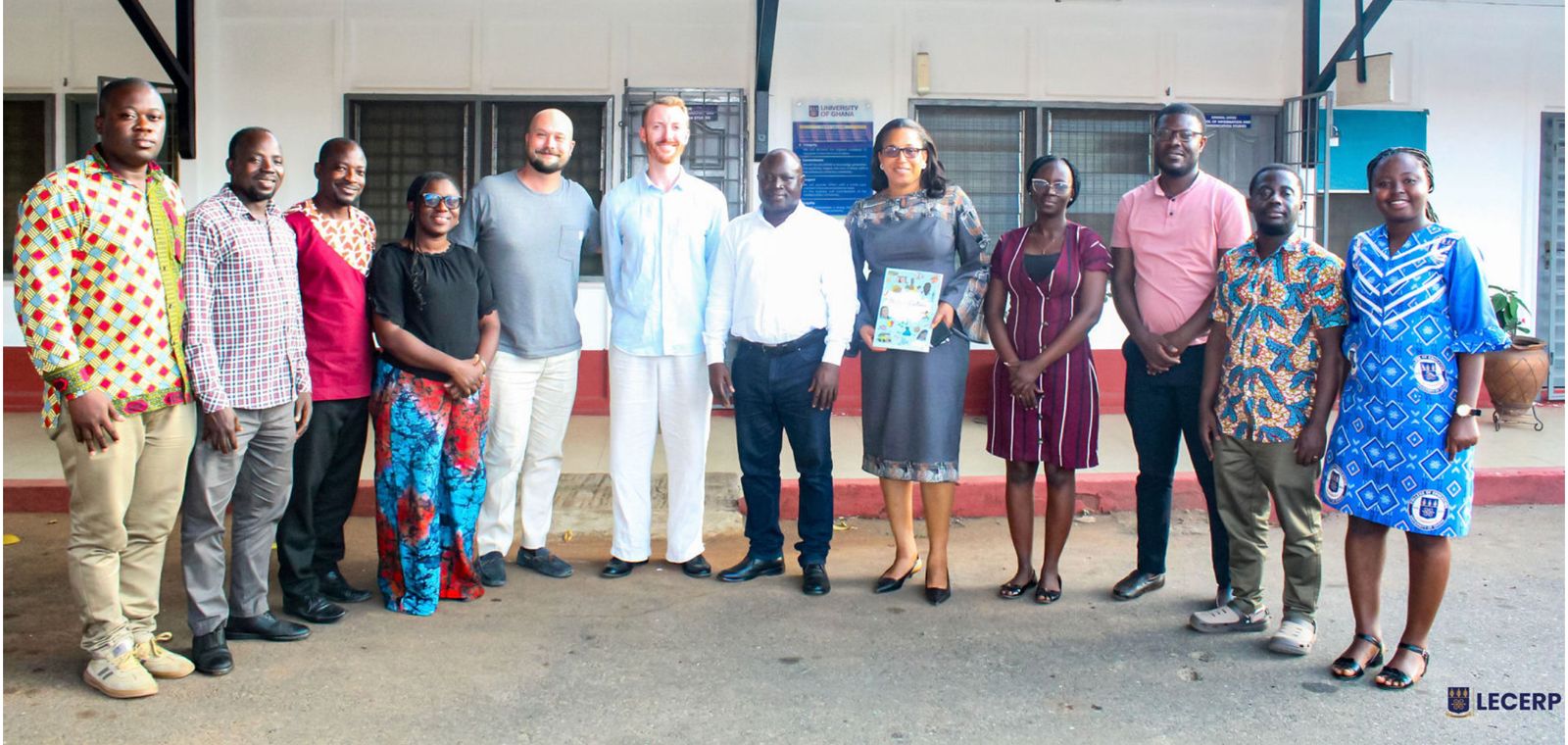
Team partners from LECERP and Project Partners Education at the meeting.
The Legon Centre for Education Research and Policy (LECERP), University of Ghana, has
hosted a delegation from Project Partners Education, a UK-based educational charity, to
explore research and evaluation partnership on Project Maths: Ghana, an intervention aimed
at improving mathematics teaching and learning in Ghana.
The meeting provided an opportunity for both teams to share their work, discuss the
programme’s implementation and monitoring and evaluation processes, and explore how
collaborative research could strengthen the evidence base for the programme’s next phase.
In his welcome remarks, Dr. Clement Adamba, Director of LECERP, expressed optimism
about the prospects for collaboration and highlighted the Centre’s three pillars of research,
training and capacity building, and policy engagement and advocacy. He emphasised the
importance of translating research findings into practical insights that inform educational
practice, reach communities and support evidence-informed policymaking. He also
underscored the need to systematically assess projects to determine their impact on
beneficiaries and establish whether they are achieving their intended outcomes.
Dr. Innocent Agbelie, Research Fellow at LECERP, subsequently presented an overview of
the Centre’s research priorities and ongoing initiatives. He highlighted LECERP’s
commitment to advancing education research in support of the University of Ghana’s
aspiration to become a world-class research institution. He also outlined the Centre’s
advocacy and capacity-building initiatives.
Speaking on behalf of Project Partners Education, Mr. Tom Shering, Chief Executive Officer
(CEO) and founder of the the charity, explained that the organisation was established on the
principle that education should extend beyond memorisation and examination preparation to
embrace practical learning connected to everyday life. He introduced Project Maths: Ghana as an initiative that seeks to make mathematics more engaging and meaningful for teachers
and learners.
Building on this overview, Mr. Jonny Jackson, Chair of Project Partners Education, outlined
the programme’s approach to mathematics instruction, which incorporates narrative, creative
and collaborative methods to help teachers present mathematical concepts in engaging and
relatable ways. He also explained that participating teachers reflect on their classroom
experiences after each course and receive feedback to support their professional development
and application of the approaches in their teaching.
Following the presentations, discussions focused on strengthening the programme’s
monitoring and evaluation framework to generate robust evidence of its effectiveness. Both
teams explored opportunities for collaborative research to assess changes in teachers’
knowledge and classroom practices, as well as the programme’s potential impact on learner
outcomes. The discussions also highlighted the potential roles of coaching, mentorship and
head teachers in reinforcing teachers’ professional development and sustaining improvements
in classroom practice.
In his closing remarks, Dr. Adamba thanked the delegation for the engagement and
reaffirmed LECERP’s commitment to partnerships that advance education research and
strengthen the links between evidence and policy. He expressed optimism about the potential
collaboration and its contribution to generating evidence that could inform mathematics
teaching and learning in Ghana.
The engagement marks a step towards potential collaboration between LECERP and Project
Partners Education, with both teams seeking to strengthen the evidence base for mathematics
education and support the development of effective and sustainable teaching and learning.